Showing posts with label acrylic. Show all posts
Showing posts with label acrylic. Show all posts
Saturday, November 26, 2011

Monday, November 14, 2011


Tuesday, November 1, 2011
Yarn Basics: Yarn Stores
There are a variety of stores, both
online and offline, that sell yarn and other knitting accessories. In
this article, different types of yarn stores will be discussed,
including major retail chains, local yarn shops (LYS), online
retailers, and the unexpected places.

Retail chains
There are many large retail chains that
either specialize in yarn and crafting supplies, or carry a diverse
amount of them. These are usually multi-state stores such as WalMart,
Joann's Fabrics, Michael's Crafts, A.C. Moore, Hobby Lobby, and Ben Franklin. These stores generally have sales/coupons advertised
online, and specialty coupons sent via email or regular mail if you
sign up for their newsletter. Prices can vary as well as selection.
Most craft stores carry a variety of brand name yarns as well as
accessories such as knitting needles and stitch holders. You can
order online or visit them in their store.

Local yarn shops (LYS)
Local yarn shops are a wonderful way to
get more up close and personal with a range of higher quality yarns.
These shops are generally locally owned and run and can provide a
more intimate purchasing experience. While the yarns can be more
expensive, they are generally more luxuriant and made with much
higher quality materials than you will find in general retail chain
craft stores. These stores also have knitting accessories, some
handmade. These can be harder to find, but check your local telephone
directory for information on these local treasures.

Online retailers
There are too many of these to name,
and many are so amazing! There are the yarn brand websites, such as
Red Heart, Bernat's, Caron, Patons, and Lion Brand. There are also
online versions of local yarn shops such as Ice, Herrschners,
Annie's Attic, Knit Picks, Knitting Warehouse, Smiley's Yarns, WEBS,
and Deramores. There are also a large amount of exceptionally
talented individual retailers who spin and dye their own handpainted
yarns. These you can find by searching such places as Etsy, Ebay,
ArtFire, and Ravelry. A large number of online groups for knitting,
yarn, spinning, and dyeing exist as well. You can search these types
of groups to find individuals who sell yarn.
Unexpected Places
A few places that are unexpected can
often lead to the cheapest yarn! Be sure to check places such as
your local Goodwill, Salvation Army, and other second-hand stores frequently, as
they tend to have large lots or bags of yarn very inexpensively.
Sometimes they will not have labels though, so it can be a grab bag.
Other good places to look for yarn are estate sales, garage sales,
classified ads, and places such as Craigslist for your area.
This is an overview of various places
that yarn can be purchased. The stores listed are merely examples,
and this is not an exhaustive list. Use search engines to your
advantage to find amazing yarns and as always, enjoy!
Monday, October 31, 2011
Yarn Basics: Labels and How to Read Them

This is an example of a yarn label. A
yarn label contains a lot of essential information about that
particular yarn. In this example, you can see the name of the company
that produces the yarn, the name of the yarn, and the weight of the
yarn in the top section of the label.
This yarn is a worsted weight yarn
called Cascade 220 Superwash. It is produced by Happy Knits, Inc.
Their website is also listed.
Next you see the fiber content. This
particular yarn is 100% superwash wool. Below the fiber, you see the
quantity of wool in grams (100 g) and ounces (3.5 oz) as well as the
length in both meters (200 m) and yards (220 yds).
Beneath the yarn fiber/length
information, you find the gauge. In this example, gauge for both US
size 7 and US size 6 knitting needles is given. Please see my article
on gauge and how it works here!
Next is information on where the yarn
is produced and who distributes it. Below this information you find
the care instructions, which are extremely important. For example, if
you wash a handwash wool in a washing machine, you may find a piece
of felt waiting for you instead of your original creation. So
please, check the washing instructions carefully!
Next you see the color and lot numbers.
These are also essential to understand, especially when making
something that uses more than one skein of yarn. If you are making
something which uses multiple skeins, such as a sweater, it is
important to make sure that you are using the same color and dye lot,
or else there can be slight discrepancies in the color. So make sure
to purchase enough yarn in the same lot to complete your project!
This is an overview of a yarn label and
how to understand what is on it. Understanding your yarn will make
each project more enjoyable!
Saturday, October 29, 2011
Yarn Basics - Yarn Fibers
There are many different yarn fibers available in all yarn weights. Each type of yarn fiber has its own attributes, and the fiber you will use will depend on the type of project you are doing. Below is a short summary of some basic yarn fibers, their qualities, and projects they are suited for.
Wool: Wool is a very popular fiber used in a variety of projects from scarves to socks. The fleece used to spin wool yarn comes from different breeds of sheep and different shearing. Wool is very warm, comes in a washable variety (superwash) and can also be used for felted projects. Some people are allergic to wool though, and others find pure wool itchy and harsh to work with.

Fleece: Fleece is a term used for the fleece of animals other than sheep. Common yarns are mohair, cashmere, and other angora blends. The fleece used to spin these yarns comes from goats and rabbits. These yarns are incredibly soft and work up quickly, making luxurious items. These yarns are generally more expensive.

Synthetic: The most common synthetic yarn is acrylic, which can vary in quality from brand to brand. It is a very easy yarn to work with. Acrylic can be washed/dried in appliances and is also very inexpensive, making it a popular yarn choice for baby projects, pet projects, afghans, and other well-loved items. Acrylic yarns come in a dazzling array of colors and all yarn weights. The downside is since acrylic is plastic, the yarn can lack the softness and definition of other fibers. It also will melt if heated, so using acrylic for a project such as a potholder would not be appropriate.

Cotton: Cotton yarn is also referred to as kitchen yarn. Most items you would find use for in a kitchen or bathroom (such as washcloths, towels, etc) are made from kitchen cotton yarn. This yarn is machine washable, absorbs water well, and holds up to wear. Cotton is a wonderful yarn to use for garments as well, due to its softness. But keep in mind that cotton does shrink when machine washed/dried.

Novelty: Novelty yarns are fun yarns to use for various projects. They are extremely different from traditional yarns. Some examples of novelty yarns are ribbon, boucle, chenille, fake fur, and thick-thin yarn. These are fun yarns to play with for projects such as a “fur” scarf, boucle blankets, and textured thick-thin hat.
Thick-thin:
Boucle:
Fake fur:
Blends: There are many variations of blended yarns. These yarns blend two or more yarn fibers together to maximize positive attributes and minimize the negative attributes of each yarn. Common blends are cotton/acrylic, wool/acrylic, cotton/bamboo, wool/nylon/spandex, etc. There are countless ways to blend yarns, so you will find many varieties!
Bamboo blend:
There are other yarns that have not been mentioned here, but these are some of the basic fibers that are frequently used. Familiarize yourself with the large variety of fibers available and, if you are able, go to a local yarn shop so you can see and feel the different yarn fibers. This will help you to develop your yarn eye.
Happy yarn shopping!
Wool: Wool is a very popular fiber used in a variety of projects from scarves to socks. The fleece used to spin wool yarn comes from different breeds of sheep and different shearing. Wool is very warm, comes in a washable variety (superwash) and can also be used for felted projects. Some people are allergic to wool though, and others find pure wool itchy and harsh to work with.
Fleece: Fleece is a term used for the fleece of animals other than sheep. Common yarns are mohair, cashmere, and other angora blends. The fleece used to spin these yarns comes from goats and rabbits. These yarns are incredibly soft and work up quickly, making luxurious items. These yarns are generally more expensive.
Synthetic: The most common synthetic yarn is acrylic, which can vary in quality from brand to brand. It is a very easy yarn to work with. Acrylic can be washed/dried in appliances and is also very inexpensive, making it a popular yarn choice for baby projects, pet projects, afghans, and other well-loved items. Acrylic yarns come in a dazzling array of colors and all yarn weights. The downside is since acrylic is plastic, the yarn can lack the softness and definition of other fibers. It also will melt if heated, so using acrylic for a project such as a potholder would not be appropriate.
Cotton: Cotton yarn is also referred to as kitchen yarn. Most items you would find use for in a kitchen or bathroom (such as washcloths, towels, etc) are made from kitchen cotton yarn. This yarn is machine washable, absorbs water well, and holds up to wear. Cotton is a wonderful yarn to use for garments as well, due to its softness. But keep in mind that cotton does shrink when machine washed/dried.
Novelty: Novelty yarns are fun yarns to use for various projects. They are extremely different from traditional yarns. Some examples of novelty yarns are ribbon, boucle, chenille, fake fur, and thick-thin yarn. These are fun yarns to play with for projects such as a “fur” scarf, boucle blankets, and textured thick-thin hat.
Thick-thin:
Boucle:
Fake fur:
Blends: There are many variations of blended yarns. These yarns blend two or more yarn fibers together to maximize positive attributes and minimize the negative attributes of each yarn. Common blends are cotton/acrylic, wool/acrylic, cotton/bamboo, wool/nylon/spandex, etc. There are countless ways to blend yarns, so you will find many varieties!
Bamboo blend:
There are other yarns that have not been mentioned here, but these are some of the basic fibers that are frequently used. Familiarize yourself with the large variety of fibers available and, if you are able, go to a local yarn shop so you can see and feel the different yarn fibers. This will help you to develop your yarn eye.
Happy yarn shopping!
Saturday, October 1, 2011
Beginner Information - Needles
For those who are new to knitting, there are few things more important than the basics - knitting needles and yarn. We will discuss knitting needles first. There are many different kinds of needles, and they are used for different things. Once you have chosen your project (a good beginner project is a simple scarf), you will see information for the size of the needle to use and the type of yarn (weight and fiber content.) Needle sizes will range from size 0 to size 50. Size 0 is the thinnest needle and size 50 needles are large as broom handles!

As you can imagine, choosing the right size needle for your project, especially for size sensitive projects such as garments, is of utmost importance. A pattern will indicate the size needle that you should use, but you should always double check by checking the gauge. I will post another blog post on gauge and how to determine if you are using the correct size needles, because it is so important!
So once you have the correct size needles, you will have to determine what material you prefer for your knitting needles. There are three basic materials used for knitting needles: wood, acrylic/plastic, and metal. It is personal preference which you prefer, and I would suggest trying each type. Generally, wood is the least slippery of all the needle types and has the most amount of drag. This is useful if you are working with slippery yarns. Wood needles are often made of bamboo and are flexible and very lightweight.

Acrylic needles are made of plastic, and they are considered a good all-around needle with a slight drag.

Metal needles are quite slippery, which makes them a good needle to use with yarns that are heavier and drag such as cotton. The disadvantage to metal needles is the larger needles tend to be rather heavy, even the metal plated aluminum needles.

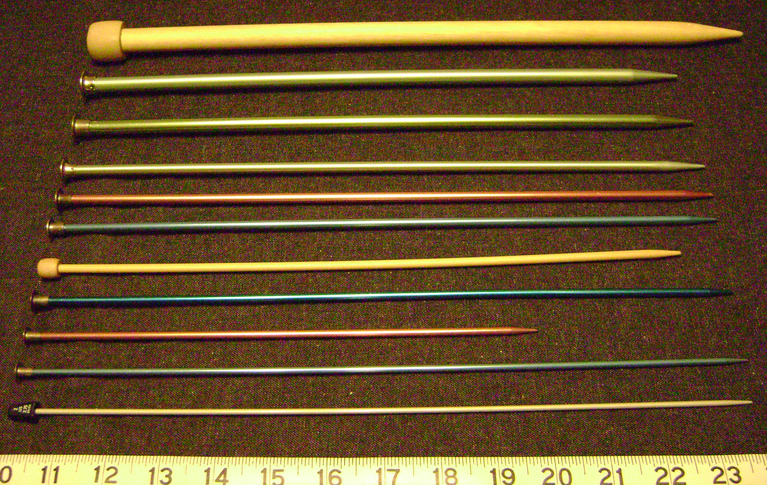
One last, yet important, feature you will need to consider when selecting a knitting needle is the type of needle you need for your project. There are single-pointed needles (straight), circular needles, and DPNs (double pointed needles.) Straight needles are very straightforward. They are simply needles which have a single point on one end and a cap on the other end. They can vary in length, but generally are around 9 inches long. They work well when knitting something that is one dimensional, such as a scarf.
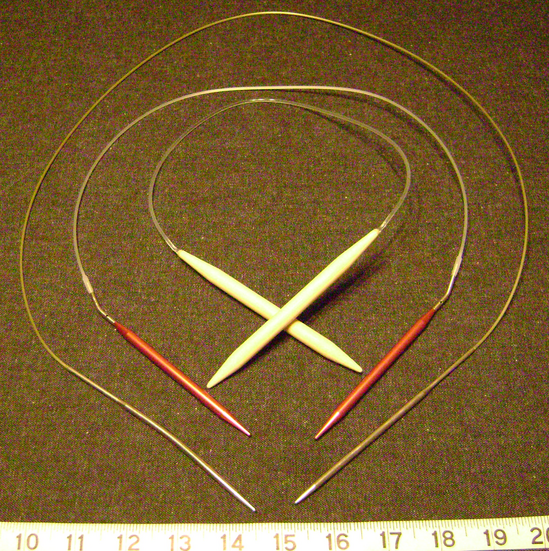
Circular needles are the most varied, and most used, knitting needle type. They are created by connecting knitting needle tips with a flexible cord. Circular needles allow you to knit circular items, such as hats. They also provide advantages for knitting large projects, as the bulk of the project will rest in your lap on the flexible cord.
There are fixed circular needles and interchangeable circular needles. Fixed circular needles are needle tips connected permanently to a flexible cable. These tips come in all material types and sizes. The cable on the fixed circular needles can range in size from 9" long to 60" or longer. Interchangeable needles come in sets, and have separate needle tips and cables. The advantage is you purchase one set of needle tips and you can use them on several different cable lengths, depending on your project. The disadvantage is the tips connect to the cable via a "join" and are tightened with a cable key. Occasionally there have been complaints of the tips slipping free from the cable, which can result in loss of your knitting work. This rarely occurs if you tighten the join according to the manufacturer instructions.
The last type of knitting needles are the double-pointed needles. These are straight like the single-pointed needles, but both ends are pointed. These also come in various lengths and needle sizes, and they are frequently used when knitting socks. You can also use them to knit things that are circular.

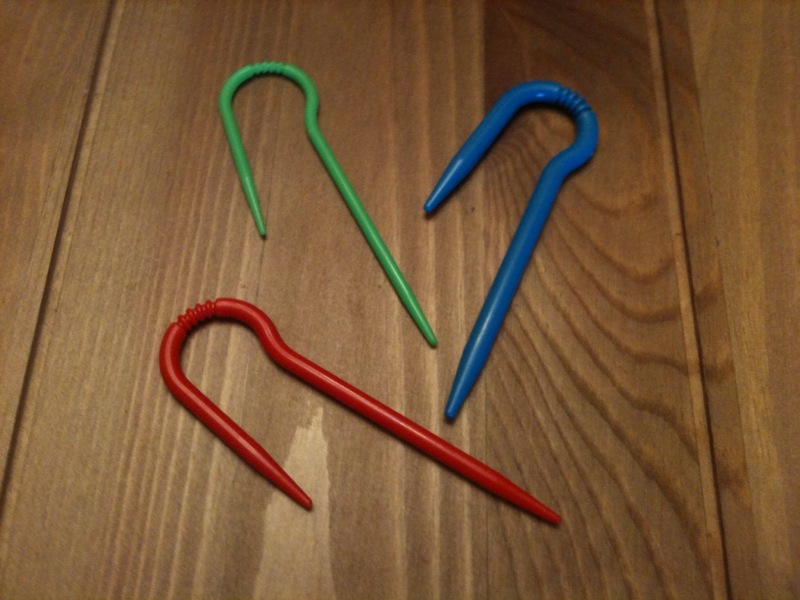
A last needle type, though not used in the same way the other knitting needles are, is the cable needle. A cable needle is a specialized needle used when making the cable stitch. Cable needles come in various shapes and sizes, as well as different materials and thicknesses.

As you can imagine, choosing the right size needle for your project, especially for size sensitive projects such as garments, is of utmost importance. A pattern will indicate the size needle that you should use, but you should always double check by checking the gauge. I will post another blog post on gauge and how to determine if you are using the correct size needles, because it is so important!
So once you have the correct size needles, you will have to determine what material you prefer for your knitting needles. There are three basic materials used for knitting needles: wood, acrylic/plastic, and metal. It is personal preference which you prefer, and I would suggest trying each type. Generally, wood is the least slippery of all the needle types and has the most amount of drag. This is useful if you are working with slippery yarns. Wood needles are often made of bamboo and are flexible and very lightweight.

Acrylic needles are made of plastic, and they are considered a good all-around needle with a slight drag.

Metal needles are quite slippery, which makes them a good needle to use with yarns that are heavier and drag such as cotton. The disadvantage to metal needles is the larger needles tend to be rather heavy, even the metal plated aluminum needles.

One last, yet important, feature you will need to consider when selecting a knitting needle is the type of needle you need for your project. There are single-pointed needles (straight), circular needles, and DPNs (double pointed needles.) Straight needles are very straightforward. They are simply needles which have a single point on one end and a cap on the other end. They can vary in length, but generally are around 9 inches long. They work well when knitting something that is one dimensional, such as a scarf.

Circular needles are the most varied, and most used, knitting needle type. They are created by connecting knitting needle tips with a flexible cord. Circular needles allow you to knit circular items, such as hats. They also provide advantages for knitting large projects, as the bulk of the project will rest in your lap on the flexible cord.
There are fixed circular needles and interchangeable circular needles. Fixed circular needles are needle tips connected permanently to a flexible cable. These tips come in all material types and sizes. The cable on the fixed circular needles can range in size from 9" long to 60" or longer. Interchangeable needles come in sets, and have separate needle tips and cables. The advantage is you purchase one set of needle tips and you can use them on several different cable lengths, depending on your project. The disadvantage is the tips connect to the cable via a "join" and are tightened with a cable key. Occasionally there have been complaints of the tips slipping free from the cable, which can result in loss of your knitting work. This rarely occurs if you tighten the join according to the manufacturer instructions.

The last type of knitting needles are the double-pointed needles. These are straight like the single-pointed needles, but both ends are pointed. These also come in various lengths and needle sizes, and they are frequently used when knitting socks. You can also use them to knit things that are circular.

A last needle type, though not used in the same way the other knitting needles are, is the cable needle. A cable needle is a specialized needle used when making the cable stitch. Cable needles come in various shapes and sizes, as well as different materials and thicknesses.

Subscribe to:
Posts (Atom)